Vacuum Forming Materials Guide: Choose the Right Thermoforming Plastic Sheets for Your Project

Key Factors to Consider When Choosing Vacuum Forming Materials
1. Project Requirements & End-Use
- Durability Needs: Will the product withstand impact (e.g., automotive parts) or harsh environments (e.g., outdoor signage)?
- Aesthetics: Do you need transparency (e.g., display cases), color options (e.g., cosplay props), or a matte finish (e.g., industrial covers)?
- Regulatory Compliance: Is food safety (FDA approval) or medical-grade sterility required (e.g., medical trays)?
- Size & Scale: For large-format vacuum forming projects (e.g., billboards, architectural panels), prioritize materials with excellent stretchability and uniform thickness retention.
2. Vacuum Forming Machine Compatibility
- Heating Capacity: Thicker materials (≥0.25”) require machines with high-power heaters (e.g., double-heater vacuum forming machines) to ensure even softening.
- Forming Depth: Deep-cavity projects need materials with good elongation (e.g., PETG, ABS) to avoid tearing during the vacuum process.
- Machine Type: DIY or tabletop machines work best with thin-gauge materials (≤0.125”), while industrial vacuum forming machine models handle thick-gauge sheets (≥0.25”) for heavy-duty applications.
3. Cost & Production Efficiency
- Material Cost: Budget-friendly options (e.g., PS, PVC) suit low-volume or disposable products, while premium materials (e.g., PC, Acrylic) justify higher costs for long-lasting, high-performance parts.
- Processing Ease: Some materials (e.g., PETG) heat quickly and form smoothly, reducing cycle times on your vacuum forming machine.
- Waste Reduction: Materials with consistent thickness (e.g., ABS, PP) minimize scrap in high-volume production.
Top 8 Vacuum Forming Materials (Properties & Applications)
| Material | Key Properties | Thickness Range (Vacuum Forming) | Ideal Use Cases | Compatibility with Vacuum Forming Machines | Cost (Relative) |
|---|---|---|---|---|---|
| PVC (Polyvinyl Chloride) | – Affordable, versatile
– Good rigidity & tensile strength – Chemical-resistant – Available in clear/colored options |
0.06”–0.50” | – Advertising signage
– Packaging (blister packs, clamshells) – Home decor (wall panels, trim) – Toys & consumer goods |
Works with all machines (DIY to industrial); ideal for large-format vacuum forming due to low cost and stretchability | Low |
| Acrylic (PMMA) | – Crystal-clear (92% light transmission)
– Scratch-resistant & UV-stable – Rigid, high-gloss finish – Moderate impact resistance |
0.08”–0.75” | – Display cases & retail fixtures
– Illuminated signage – Cosplay props (armor, masks) – Architectural glazing |
Requires precise temperature control (avoid overheating); pairs well with tabletop or industrial vacuum forming machine for detailed parts | Medium-High |
| ABS (Acrylonitrile Butadiene Styrene) | – High impact resistance
– Rigid & durable – Good chemical resistance – Paintable/printable |
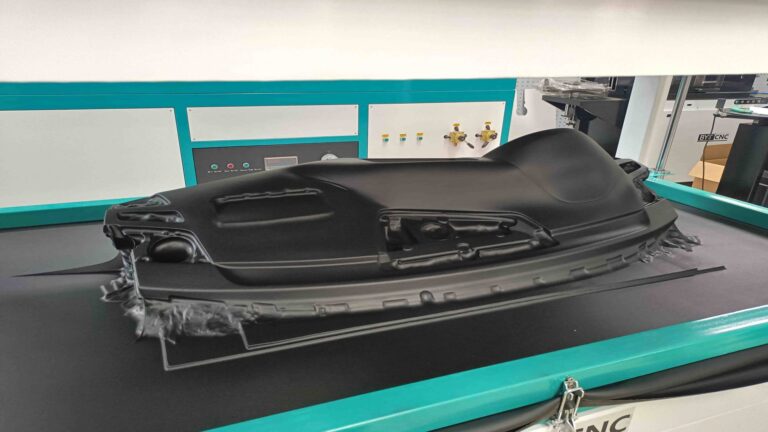
0.12”–0.60” | – Automotive interior parts (door panels, dash trim)
– Industrial enclosures & machine guards – Cosplay props & film/TV set pieces – Medical equipment housings |
Compatible with semi-automatic/fully automatic machines; excellent for deep-cavity forming and large-format vacuum forming (e.g., vehicle body panels) | Medium |
| PETG (Polyester Copolymer) | – Food-safe (FDA-approved)
– High clarity & impact resistance – Easy to form (low melting point) – Recyclable |
0.06”–0.40” | – Food packaging (trays, containers)
– Medical devices (sterile trays) – Retail displays & point-of-purchase stands – Electronic device covers |
Perfect for DIY and industrial machines; fast heating reduces cycle times—ideal for high-volume production | Medium |
| PP (Polypropylene) | – Lightweight & flexible
– Heat-resistant (up to 220°F) – Chemical-resistant – FDA-approved for food contact |
0.08”–0.50” | – Food storage containers
– Industrial chemical tanks – Lawn & garden equipment (mower covers) – Automotive underbody components |
Requires slower heating (avoid cold spots); works with industrial vacuum forming machine for heavy-duty applications | Low-Medium |
| PS (Polystyrene) | – Low cost & lightweight
– Easy to form (fast heating) – Available in rigid or foam variants – Good dimensional stability |
0.04”–0.30” | – Disposable food packaging (deli trays, cups)
– Toy parts & hobby kits – Prototyping & short-run production – Blister packs for electronics |
Best for DIY/tabletop machines; not recommended for large-format vacuum forming (low impact resistance) | Low |
| PC (Polycarbonate) | – Virtually unbreakable (250x stronger than glass)
– UV-stable & heat-resistant – High impact resistance – Clear or tinted options |
0.12”–1.00” | – Safety shields & machine guards
– Aircraft trim & skylights – Medical imaging components (CT/MRI parts) – Outdoor durable signage |
Requires high-power heaters (double-heater machines); ideal for industrial vacuum forming machine—excellent for large, high-stress parts | High |
| PE (Polyethylene) | – Water-resistant & chemical-resistant
– Flexible & durable – Stable in cryogenic environments – Low cost |
0.08”–0.60” | – Industrial packaging (bins, drums)
– Marine components (boat hulls) – Agricultural equipment covers – Food processing containers |
Works with industrial machines; good for large-format vacuum forming (e.g., storage tanks) due to flexibility | Low-Medium |
Watch this video to see how hard-case luggage is produced using vacuum forming.
Material Selection Guide by Project Type
1. Large-Format Vacuum Forming Projects
- Applications: Billboards, architectural panels, large signage, vehicle body panels.
- Top Materials: PVC (cost-effective), ABS (durability), PETG (ease of forming).
- Recommended Machine: Industrial large-format vacuum forming machine (e.g., HXS-1224) with extended worktables (≥48”x48”) and high-power heaters for uniform heating of large sheets.
- Pro Tip: Choose materials with elongation rates ≥150% (e.g., ABS, PETG) to avoid tearing during deep forming.
2. Food & Medical Applications
- Applications: Food trays, sterile medical trays, blister packs for pharmaceuticals.
- Top Materials: PETG (food-safe, recyclable), PP (heat-resistant), PC (sterilizable).
- Recommended Machine: Semi-automatic vacuum forming machine with cleanroom-compatible design and precise temperature control (avoids material contamination).
- Pro Tip: Verify FDA/NSF certification for food contact; opt for medical-grade PC or PETG for sterile environments.
3. Cosplay & Entertainment
- Applications: Props (armor, weapons), masks, film/TV set pieces.
- Top Materials: Acrylic (clarity), ABS (durability), PETG (easy to trim/finish).
- Recommended Machine: Tabletop or DIY vacuum forming machine (for small batches) or semi-automatic machines (for large productions).
- Pro Tip: Use ABS for rigid props (e.g., armor) and PETG for flexible parts (e.g., masks)—both are easy to paint and modify.
4. Industrial & Automotive
- Applications: Machine guards, automotive interior parts, industrial enclosures.
- Top Materials: PC (impact resistance), ABS (rigidity), PP (chemical resistance).
- Recommended Machine: Fully automatic vacuum forming machine with plug-assist technology (ensures even thickness for high-stress parts).
- Pro Tip: For automotive parts, choose UV-stable materials (e.g., ABS with UV inhibitors) to prevent fading.
Vacuum Forming Materials FAQs (Solutions to Common Problems)
Q1: Which material is best for beginners using a DIY vacuum forming machine?
Q2: Can I use thermoforming plastic sheets for large-format vacuum forming without tearing?
Q3: How do I prevent warping when vacuum forming thick-gauge materials?
Q4: Are there eco-friendly vacuum forming materials?
Q5: Can I paint or print on vacuum formed parts?
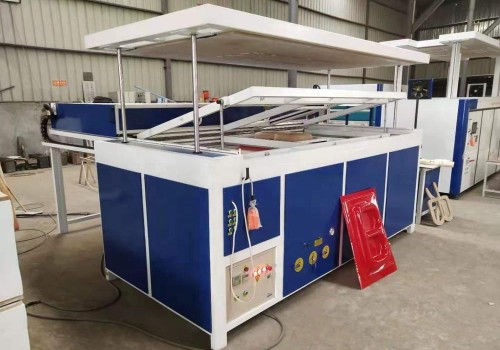
Case Study: Matching Materials to a Large-Format Vacuum Forming Machine
Project: 8’x10’ Illuminated Acrylic Sign for a Retail Store
- Challenge: Produce a clear, durable sign that withstands outdoor weather and fits the store’s branding.
- Material Selected: 0.25” Clear Acrylic (PMMA)—offers high clarity, UV stability, and rigidity.
- Vacuum Forming Machine: BSX-1224 Large-Format Vacuum Forming Machine (1200x2400mm worktable, dual heaters).
- Process & Results:
- The machine’s dual heaters evenly heated the acrylic sheet to 280°F (avoiding yellowing).
- Plug-assist technology ensured the sheet conformed to the sign’s curved edges without thinning.
- Water-cooled molds reduced warping, resulting in a flat, clear sign that retained its shape.
- Outcome: The sign lasted 5+ years outdoors, with no fading or cracking—proving the value of pairing Acrylic with a purpose-built large-format vacuum forming machine.

Final Tips for Successful Vacuum Forming Material Use
- Test First: Always run a small sample with your chosen material and vacuum forming machine to adjust heating time, vacuum pressure, and cooling speed.
- Store Materials Properly: Keep thermoforming plastic sheets in a dry, cool area (avoid direct sunlight) to prevent warping before use.
- Match Thickness to Machine: DIY machines handle ≤0.125” sheets; industrial machines can process up to 1.00” thick materials—using the wrong thickness leads to incomplete forming.
- Consider Post-Processing: Choose materials that align with your finishing steps (e.g., Acrylic for polishing, ABS for painting).